
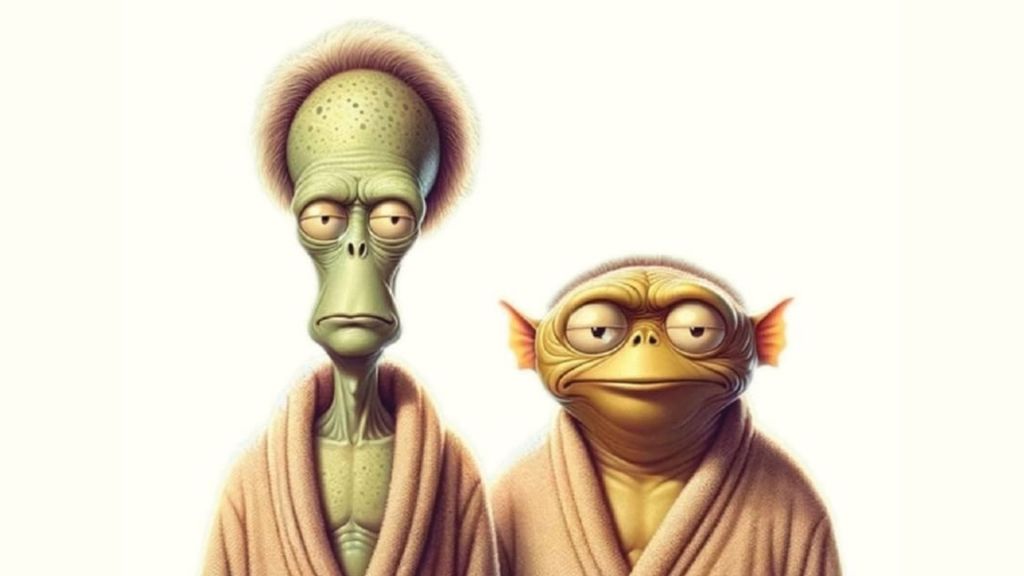
What inspired The Jacksons’ Debate? Where was the seed planted that led to its creation?
This is a big question, one that takes me back to my university years studying law, when I was deciding what path I wanted to follow.
So there we are, it is 2019, and I had just returned from my time abroad in Dublin. At that point, I was fascinated with scientific questions, more precisely, with applying a scientific approach to the challenges that arise in life. This meant being sceptical, relying on evidence to form my views, while also remaining flexible enough to let better evidence reshape my assumptions.
That might be the biggest lesson I took from The Demon-Haunted World by Carl Sagan, a book I carry with me in everything I do. Around the same time, I read The Selfish Gene by Richard Dawkins, which felt like an applied case study of the scientific method Sagan described.
This got me thinking that ultimately, all species, all living beings, are doing the same thing. Looked at from a distance, there is no fundamental difference between them. It is all life trying to survive, each species using its own method, including humans.
Of primates and science fiction
Now, turning to my interest in science fiction, which extends to fantasy as well, The Lord of the Rings for example. But the most influential for The Jacksons’ Debate was Douglas Adams. He used science fiction to explore real scientific concepts, such as infinite probability, space travel, alien races, and humans as primates. Most importantly, he depicted humans as not special when viewed from an alien perspective.
At some point, I discovered the Great Ape Project and learned that both Richard Dawkins and Douglas Adams had written essays in support of it. I bought and read them both. This led to my undergraduate thesis, which focused on extending human rights to all great apes, including chimpanzees, gorillas, bonobos, and orangutans.
The historical record shows that for most of Homo sapiens’ existence, humans lived in ways that were much closer to other great apes than to modern society. A comparison between early Homo sapiens and present-day chimpanzees would reveal many common behaviours and social structures. Given the genetic and cognitive similarities between humans and great apes, I questioned the justification for limiting fundamental rights to only one species while excluding the others.
“What ought to be”
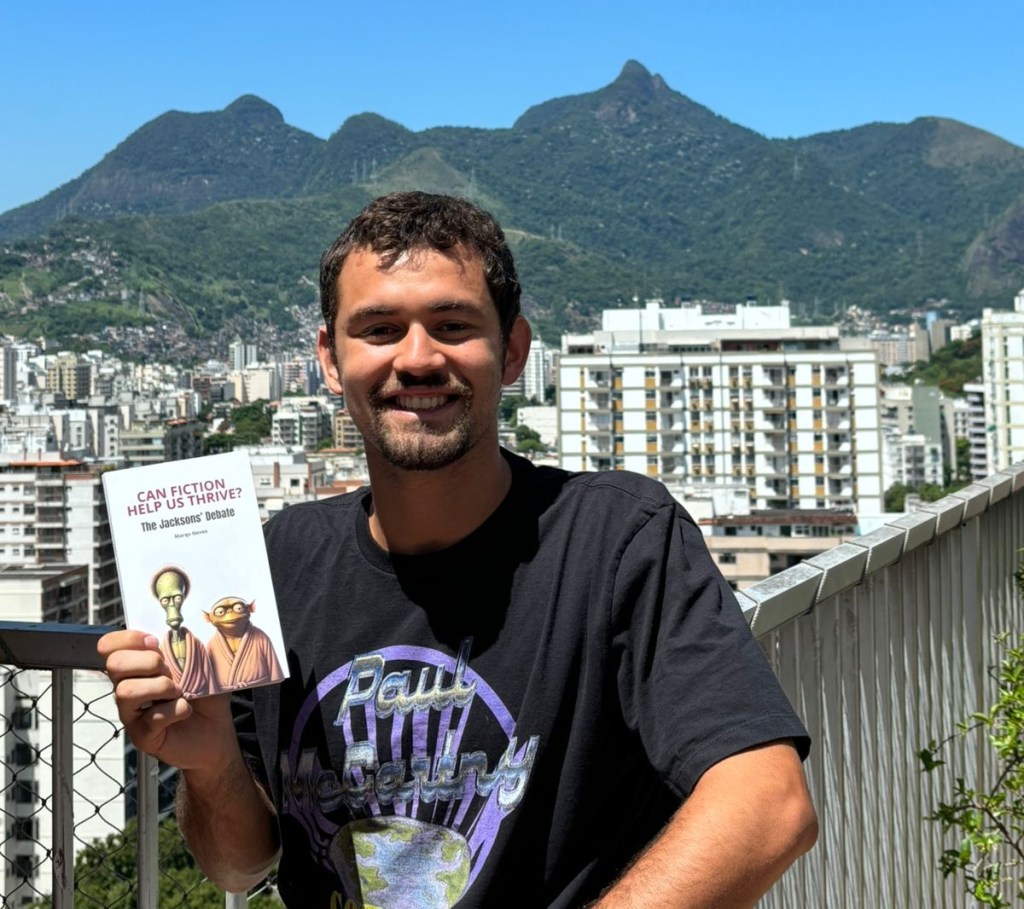
The response to this question was clear. Humans grant themselves those rights because they control the planet’s resources and shape reality to fit their beliefs. However, getting this argument across in an academic setting is not simple. It requires research, innovation, and solid evidence for every assertion.
During my master’s studies, I reached out to professors with my article Venturing Beyond Human Rights, which posed the same fundamental question. I received feedback from several notable scholars, including Carl Safina, Robert Garner, and Martha Nussbaum. But one response, in particular, stood out.
Professor Daniel Leavens at the University of Sussex told me:
“You’re concerned with questions of value, what ought to be. I don’t make my living from value-laden arguments; I argue from facts and chains of reasoning. Like many scientists, I do not think there is any ineluctable bridge from what is to what ought to be.”
This made me realise that everyone already knows our rights stem from our belief systems, not from the facts of science. That is old news. The real problem is that this understanding does not touch people emotionally, nor does it change their minds.
Hearts and minds
To illustrate this, I quote what Carl Safina told me in one of such discussions:
“To almost everyone, a person means a human being. One of the main problems with non-human personhood is that almost no one understands how a non-human could be considered a person — or why they should. (Does that include you?) I’ve watched this being argued in a courtroom in a case about two chimps, and the judges had basically no idea what the lawyer was talking about when he kept pressing the case for declaring them legal persons. That is why I do not like non-human personhood. I think it is a weak premise, and I know it communicates very poorly to virtually everyone.”
That was when I felt the urge to do something entirely different, and that became The Jacksons’ Debate. By using aliens, I could make the reader feel like the one being observed, judged, and placed under the lens of an external belief system.
Inspired by what Douglas Adams had been doing since the 1980s, I wanted to use fiction to redirect the scrutinising eye toward human belief systems. This, perhaps, could guide the reader’s thoughts toward an emotional understanding rather than a purely rationally derived argument. ★
Marqv Neves is an advocate, interested in exploring the ethical dimensions of coexistence. With a background in law and a master’s in Sustainable Development from the University of Sussex, Marqv combines his legal expertise with his interest in fiction to challenge societal norms. He’s also a researcher at the Thrive Project, where he contributes to building a future that recognizes and respects the rights of non-human beings.
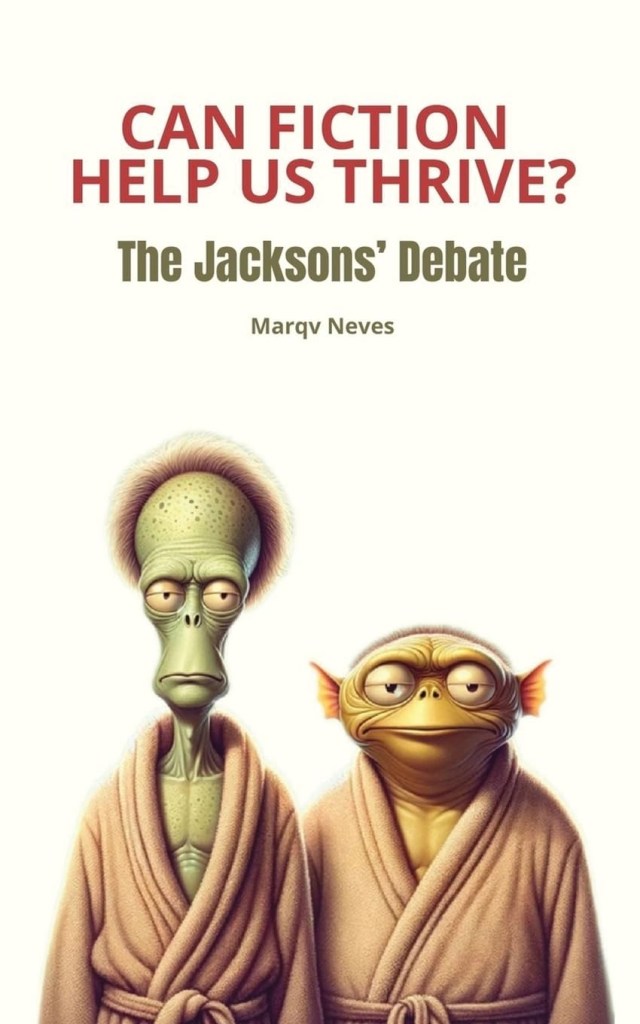
Find out more and read The Jacksons’ Debate here: THRIVE Publishing – Marqv Neves


 veganpoetry.com
Leave a comment