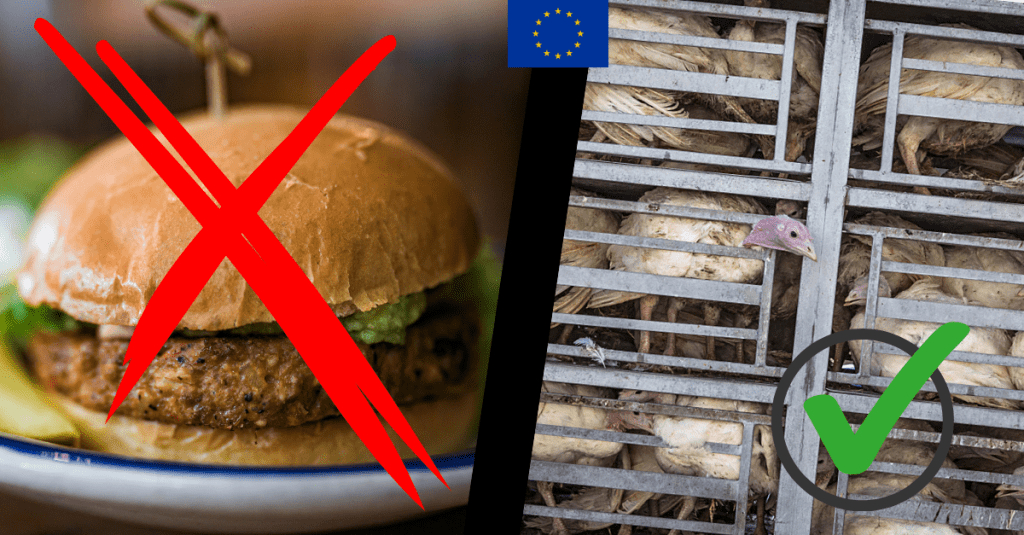
A ludicrous EU-wide brouhaha about plant-based foods using “meaty” words on packaging has led to plans for a prohibition in Poland – and now a real ban in France. Within three months, French manufacturers will face fines of 7,500 euros for printing “plant-based bacon” or “vegan steak” on non-meat products.
While this meat industry-funded fight fumbles on, the climate crisis intensifies. Unwanted records continue to fall on an almost daily basis.
Last week, the European Environment Agency (EEA) released the bloc’s first climate risk assessment. It wasn’t a pretty picture. “If decisive action is not taken now, most climate risks identified could reach critical or catastrophic levels by the end of this century,” a key takeaway reads.
Animal agriculture is responsible for at least 16.5% of global greenhouse gas (GHG) emissions. Alongside ditching fossil fuels, transitioning to a plant-based food system should be a top global priority.
The EEA report acknowledges this. It recommends that the shift towards plant-based diets “can be supported using policies targeting both supply and demand”.
So, how did no-chicken nuggets become the enemy?
Meat industry misinformation
A recent report by Nicholas Carter for the Freedom Food Alliance (FFA) delved into the details of the meat industry’s efforts to “deny, derail, delay, deflect and distract” discussions about animal agriculture’s climate impact.
Denial tactics include the absurd claim that beef farming can be carbon neutral due to natural cycles. Carter explains that this false narrative ignores the warming effect of methane. Nevertheless, it is hard to quash because it “tells a convenient story” that consumers want to hear.
When outright denial becomes untenable, delay and derail strategies eagerly pick up the baton. These time-stalling tactics can involve citing the need for more research or evidence as a way to stick to the status quo.
Deflection also helps hinder progress. Whataboutism tries to downplay the impacts of animal agriculture by comparing it to other issues. What about fossil fuels? What about planes? In fact, the dairy industry alone is responsible for more GHG emissions than all of aviation. Jobs! Almonds!
Distraction is a technique borrowed from the fossil fuel industry’s toolkit. Just as industry-funded research has long used the future prospects of carbon capture and storage as a reason to keep burning dirty stuff now, the meat lobby loves bringing up future technologies to distract from the present problem. Feeding cows seaweed may bring emissions down marginally but it is far from the “decisive action” that is urgently needed.
The FFA report outlines hundreds more examples of murky marketing techniques, including funding academic research, playing the victim and manipulating social media. This latter strategy ranges from spreading “fake news” about alternative proteins to fear-mongering about job losses and oversimplifying complex science to reach misleading conclusions.
Make marketing more honest
In this landscape of misinformation, meat industry marketing feeds consumers the “convenient story”.
In the supermarket aisle, most consumers want confirmation not confrontation. When buying unethical, unsustainable products, a reassuring label can assuage any feelings of guilt.
A paper by Suzannah Gerber, Sadie R. Dix and Sean B. Cash published last week in Business Strategy and the Environment analysed the labels of plant-based and animal products.
They found, unsurprisingly, that animals products were far less likely to mention sustainability on labels. Instead, meat and dairy played up “emotional elements”, the researchers found. They defined these as “marketing language that references nostalgia, feelings such as love and joy, or that aims to provoke an emotional response such as compassion, laughter, or belonging”.
Tugging on human heart strings to sell the butchered bodies of sentient beings is extremely callous. But it is also convincing. When buying meat, people prefer to remember the enjoyable experience of a family dinner than the fact that their food once screamed in a slaughterhouse.
Meat industry lies can be called out
Where the meat industry has tried to make environmental claims, these have sometimes resulted in legal pushback. For example, Denmark’s High Court recently ruled that meat company Danish Crown’s use of the phrase “climate-controlled pig” was greenwashing.
Similarly, meat companies are culprits of misleading or missing facts about nutrition. Some 11% of meat products analysed were missing nutritional information and ingredients lists in online marketing, compared to only 1.5% of plant-based products, the researchers found. They point to a lack of online regulation for facilitating this absence.
Labels of animal foods were also far more likely to leave off information about allergens, even when a food product did contain one or more. Allergens of animal origin are the most common source of food recalls in the UK.
Organisations and individuals do a great job of calling out the meat industry’s loose relationship with the truth. Regulators and governments need to wake up and play their part. Before it’s too late.
- Download ‘The Disinformation Report: Harvesting Denial, Distractions & Deception‘ here
- Read ‘Marketing plant-based versus animal-sourced foods in online grocery stores: A comparative content analysis of sustainability and other product claims in the United States’ here


 veganpoetry.com
Leave a comment